
Table of Contents
Clinical Summary:
The Gap: For decades, the standard surgical approach to lumbar stenosis with degenerative spondylolisthesis has been decompression plus fusion, on the assumption that the slip requires stabilization. The contemporary evidence does not support that assumption for most patients.
The Evidence: The Nordsten-DS 5-year results (BMJ 2024) found no significant difference between decompression alone and decompression plus fusion across pain, function, and quality of life outcomes. Gadjradj systematic review and Cheng meta-analysis arrive at the same conclusion.
The Takeaway: For typical grade 1 degenerative spondylolisthesis with stenosis, decompression alone is now the better-supported approach. Fusion adds operative time, blood loss, and complications without outcome benefit.
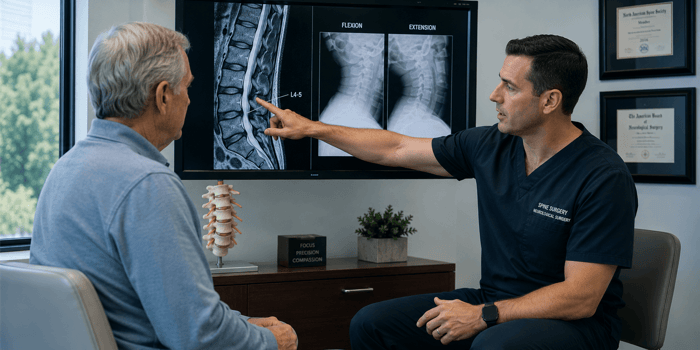
A 71-year-old patient with bilateral leg symptoms and a grade 1 degenerative spondylolisthesis at L4-L5 is scheduled for decompression plus fusion. The surgeon explains the fusion is necessary because of the slip. The patient asks if there's any way to avoid the fusion, and the surgeon explains that it would be unstable without it.
The contemporary evidence on decompression vs fusion spondylolisthesis says that conversation needs to change. The Nordsten-DS five-year results published in BMJ in 2024 directly randomized this exact patient population to the two approaches. There was no significant difference in outcomes. The Gadjradj systematic review of high-quality studies arrives at the same conclusion. The Cheng meta-analysis confirms it across multiple cohorts.
For typical degenerative grade 1 spondylolisthesis with stenosis, decompression alone is now the better-supported approach. Fusion still has indications, but they have narrowed substantially. Surgeons whose practice patterns have not updated are operating from a model the 2024 evidence directly contradicts.
The Nordsten-DS Trial in Detail
The Nordsten-DS trial is the highest-quality direct evidence on this question. It was a multicenter randomized controlled trial conducted across Norwegian spine centers, enrolling patients with symptomatic lumbar spinal stenosis and concomitant degenerative spondylolisthesis. Patients were randomly assigned to decompression alone or decompression plus instrumented fusion. Outcomes were assessed by blinded raters using validated patient-reported instruments.
The five-year results, published by Kgomotso and colleagues in BMJ in 2024, are the longest follow-up data available from a randomized comparison of these two approaches. At five years:
- Primary outcome (Oswestry Disability Index): No significant between-group difference. Both groups demonstrated substantial and durable improvement.
- Leg pain: No significant difference.
- Back pain: No significant difference.
- Quality of life (EQ-5D): No significant difference.
- Reoperation rates: Comparable between groups.
The trial was not underpowered. The design was robust. The follow-up duration is the longest available for this comparison. And the result is unambiguous: for typical degenerative grade 1 spondylolisthesis with stenosis, adding fusion to decompression does not improve clinical outcomes at five years.
Nordsten-DS 5-Year Outcome:
No Diff
Between decompression alone and decompression plus fusion across ODI, leg pain, back pain, and quality of life at 5 years.
What the Supporting Evidence Adds
The Gadjradj systematic review synthesized high-quality studies comparing decompression alone to decompression plus fusion for degenerative spondylolisthesis. The findings were consistent with Nordsten-DS: no significant difference in clinical outcomes between approaches.
The Cheng meta-analysis confirmed these findings across single-level lumbar spinal stenosis with spondylolisthesis. The pooled analysis found equivalent clinical outcomes between approaches, with decompression alone demonstrating advantages in operative time, blood loss, and complication rates.
The convergence of these three pieces of evidence, a randomized trial with five-year follow-up, a systematic review, and a meta-analysis, is what shifts the standard of care. No single study would. The aggregate is decisive.
Adding fusion to decompression for typical grade 1 degenerative spondylolisthesis adds operative time, blood loss, and complications. It does not add clinical outcome benefit. That sentence is now defensible from three independent lines of evidence.
Where Fusion Still Makes Sense
The Nordsten-DS and supporting evidence do not say fusion is never indicated. They say fusion is no longer the default for typical degenerative grade 1 spondylolisthesis. Specific indications for fusion remain:
- High-grade spondylolisthesis (grade 2 and above), where slip severity creates mechanical instability that decompression alone cannot address.
- Gross instability on flexion-extension radiographs, documented dynamic translation beyond the threshold for stable degenerative slip.
- Revision surgery in selected cases where prior decompression has created or exposed instability.
- Concurrent deformity, significant coronal or sagittal imbalance where structural correction is required.
- Specific isthmic or lytic spondylolisthesis, a different etiology with different mechanical considerations.
For these subgroups, fusion remains the appropriate procedure. They represent a minority of the spondylolisthesis-plus-stenosis population in most surgical practices.
Implications for Post-Operative Rehabilitation
For PTs and OTs receiving post-operative referrals, the practical implications are immediate:
Decompression alone has a faster rehabilitation trajectory than decompression plus fusion. Tissue healing is more limited, mobility restrictions are fewer, and progression to active loading is more rapid. The Manni systematic review on rehabilitation after lumbar stenosis surgery details the timeline differences.
Expect more decompression-alone referrals over time. As surgical practice updates, the post-operative rehabilitation caseload will shift. This is favorable for outcomes: decompression-alone patients generally recover more completely and more quickly than fusion patients.
The shared decision-making conversation pre-operatively benefits from rehabilitation involvement. Patients who understand both the conservative and surgical pathways (including the fusion-versus-no-fusion conversation) engage with whichever they choose more thoroughly.
Product Spotlight:
Lumbar Spinal Stenosis: Evidence-Based Update

$37.97
This course offers healthcare professionals a comprehensive review of lumbar spinal stenosis, focusing on differential diagnosis, validated assessment criteria, and evidence-based rehabilitation protocols. Participants will learn to differentiate stenosis types, apply clinical reasoning to complex cases, and select appropriate interventions,… read more
What to Say When the Patient Asks About Their Surgical Options
Non-physician clinicians are not making the surgical recommendation. They are often the clinician the patient trusts enough to ask the harder questions. Knowing what to say matters.
If asked about decompression versus fusion, a defensible response within rehabilitation scope: "There's a 2024 study from Norway that compared adding fusion versus doing decompression alone for spondylolisthesis like yours, and they didn't find a difference in outcomes at five years. That doesn't mean fusion is never the right choice. It means your surgeon should be able to tell you specifically why fusion is being recommended in your case. If the answer is just 'because there's a slip,' that's worth a follow-up conversation. If the answer is about instability on flexion-extension imaging or specific anatomic factors, that's a different conversation."
This is a real conversation. It does not undermine the surgeon. It respects the patient's autonomy and aligns the rehabilitation team with the contemporary evidence. Surgeons who are current on the literature will say the same thing.
In the Cheng meta-analysis, decompression alone demonstrated advantages in three operative parameters: shorter operative time, lower blood loss, and lower complication rates. None of these benefits sacrifice clinical outcome compared to fusion. The procedure that is faster, safer, and produces equivalent outcomes is the procedure the evidence now supports as default.
Where This Fits in the Broader Stenosis Evidence
The Nordsten-DS finding is one of three pieces of recent evidence that have most directly reshaped the stenosis algorithm. The full operating model sits in the lumbar spinal stenosis rehabilitation pillar. The surgery-versus-rehabilitation comparison data sits in the surgery vs rehabilitation comparison. And the broader six myths that often shape surgical decision-making are addressed in the six myths the 2024 evidence contradicts.
The Bottom Line
The evidence on decompression vs fusion spondylolisthesis for typical degenerative grade 1 slip has settled. Three independent lines of high-quality evidence converge on the same finding: no significant outcome difference, with decompression alone offering shorter operative time, less blood loss, and fewer complications. Fusion still has indications, but they are narrower than current practice patterns reflect. Patients asking why fusion is being recommended in their specific case deserve a specific answer.
FAQs
Does the Nordsten-DS evidence on decompression vs fusion spondylolisthesis apply to all spondylolisthesis grades?
No. The trial enrolled patients with typical degenerative grade 1 spondylolisthesis. The findings do not extend to high-grade slip (grade 2+), isthmic or lytic spondylolisthesis, or cases with documented gross instability. For those patients, fusion may still be the appropriate procedure. For the most common presentation (grade 1 degenerative slip with stenosis) decompression alone is now the better-supported approach.
If outcomes are equivalent at five years, are there reasons a surgeon might still recommend fusion?
Yes, in specific situations: documented dynamic instability on flexion-extension imaging, concurrent deformity requiring structural correction, or revision surgery exposing instability. Outside these specific indications, the default-to-fusion practice pattern is not supported by the contemporary evidence and warrants a conversation about why fusion is being recommended in a specific case.
How long does post-operative rehabilitation typically take for decompression alone versus fusion?
Decompression alone: most patients are walking independently within 1-2 weeks, returning to light activity within 4-6 weeks, and resuming pre-operative activity levels within 8-12 weeks with appropriate rehabilitation. Fusion adds 4-12 weeks to most milestones due to tissue healing and bone consolidation requirements. The shorter recovery is one of the practical advantages of decompression alone for the patients in whom fusion is not indicated.
What outcome measures should rehabilitation track for post-operative stenosis patients?
The Oswestry Disability Index, EQ-5D-5L, leg pain numeric rating, back pain numeric rating, and Timed Up and Go are the most useful for tracking recovery trajectory. These instruments were used in Nordsten-DS and are sensitive to change in this population. Walking capacity (self-reported maximum walking distance) provides functional context that resonates with patient goals.
Does the decompression-versus-fusion finding apply to multi-level stenosis or only single-level?
The strongest evidence (Nordsten-DS, Cheng meta-analysis) addresses single-level decompression. The principles likely extend to multi-level cases without instability, though the specific evidence is thinner. Multi-level decompression with concurrent multi-level instability is a different decision; surgeon judgment on a case-by-case basis remains appropriate.