
Table of Contents
Clinical Summary: Why AI in Healthcare Matters for Rehab Therapists
AI in healthcare isn't just for hospitals and health systems - it's here, it's practical, and it's already saving PT and OT clinicians time every single day.
The three workflows below don't require a technology overhaul. They require a willingness to try. Whether you're cleaning up a SOAP note, simplifying a concept for a patient, or tracking down a clinical practice guideline, AI handles the friction so you can focus on the patient in front of you.
The bottom line: Less time on tasks. More time on care.
Artificial intelligence in healthcare doesn't need to be complicated to be useful.
Most clinicians don't need advanced predictive models or robotic systems to benefit from AI. What actually moves the needle day-to-day are small, repeatable workflows that reduce friction - especially around documentation, patient communication, and accessing evidence.
If used correctly, AI doesn't replace your clinical reasoning. It clears space for it.
Below are three workflows I would use in my own day-to-day practice if I were still in the clinic. These are simple, low-risk, and immediately applicable.
1. Documentation Workflow: Reduce Time Without Losing Clinical Accuracy
The Problem:
Physical therapy documentation and occupational therapy documentation are among the biggest contributors to burnout. It's repetitive, time-consuming, and often done at the end of the day when cognitive fatigue is highest. Physical therapists can spend around 30% of their workday on documentation - time that isn't spent with patients.
The Opportunity:
AI can handle structure and formatting - you handle clinical judgment.
The Workflow:
- Write or dictate your raw clinical notes (bullet points are fine)
- Paste into ChatGPT (or similar tool)
- Use a structured prompt: "Organize the following into a SOAP note. Maintain clinical accuracy. Do not add new information."
- Review carefully and edit as needed
What AI Does Well: Formatting, structuring thoughts, improving clarity.
Where to Be Careful: Hallucinations (adding details you didn't include, or generating plausible-sounding but incorrect information), over-generalization in complex cases, loss of nuance in multi-comorbidity patients.
Clinical Bottom Line: Use AI to clean up your thinking, not replace it. Use it to structure and refine your documentation - but never at the expense of patient privacy, compliance, or your clinical judgment.
Best Tool for the Job: ChatGPT (or similar general LLM)
Why: Strong at organizing, rewriting, and formatting clinical notes into structured documentation (SOAP, assessment summaries, etc.).
Best Use: Converting bullet points → SOAP format, improving clarity and flow, standardizing documentation style.
Use It When: You already have the clinical content and just need help structuring it.
Avoid Using It For: Generating clinical findings you didn't document, complex cases without careful review, or any PHI (unless using a HIPAA-compliant version approved by your employer, such as ChatGPT for Healthcare, BastionGPT, CompliantChatGPT, or Hathr.ai)
⚠️ Important: Protect Patient Privacy (HIPAA Compliance)
Before using any AI tool for documentation, make sure you are not entering Protected Health Information (PHI) into platforms that are not HIPAA-compliant. This includes but is not limited to:
- Patient names or initials
- Dates of birth or specific dates of service
- Addresses or contact information
- Medical record numbers
- Any details that could reasonably identify the patient
Best practice: Use de-identified information only (e.g., "65-year-old male with R CVA"), avoid exact dates and unique case details, and keep inputs general and clinically relevant.
Always verify your organization's current approved vendor list, as compliance status changes. If your organization has not approved a tool for HIPAA-compliant use, assume it is not safe for PHI.2. Patient Education Workflow: Translate Complexity Into Clarity
The Problem:
You understand the condition. Your patient doesn't. Explaining complex diagnoses in a way patients actually understand, without oversimplifying, is time-consuming.
The Opportunity:
AI is extremely good at translation and simplification.
The Workflow:
- Take your clinical explanation or protocol
- Paste into ChatGPT
- Prompt: "Rewrite this at a 6th-grade reading level for a patient. Keep it accurate but easy to understand."
- Optional: "Add a simple analogy to help explain the concept."
Example Use Cases: Post-op precautions, home exercise instructions, chronic condition education (OA, stroke, etc.)
What AI Does Well: Simplifies language, improves readability, speeds up handout creation.
Where to Be Careful: Oversimplification that removes key precautions, tone (can sound generic if not reviewed).
Clinical Bottom Line: You provide the clinical truth. AI helps you communicate it faster.
Best Tool for the Job: ChatGPT
Why: Excellent at simplifying complex medical language and adapting tone for different audiences.
Best Use: Rewriting instructions at a 6th grade reading level, creating patient-friendly explanations, generating analogies to improve understanding.
Use It When: You need to translate clinical knowledge into something patients can actually follow.
Avoid Using It For: Replacing your clinical judgment, providing unsupervised medical advice, situations requiring highly nuanced precautions.
3. Evidence Lookup Workflow: Stop Scouring the Internet
The Problem:
Finding and verifying clinical guidelines is slow. PubMed searches → 40 tabs → PDFs → time you don't have.
The Opportunity:
AI tools like OpenEvidence, PerplexityAI (with citations), or Google Scholar AI streamline access to peer-reviewed, citable information.
The Workflow:
- Use OpenEvidence (or similar)
- Ask a direct clinical question: "What are the current clinical practice guidelines for post-stroke gait rehabilitation?"
- Review the response with citations
- Hover or click into the source to verify
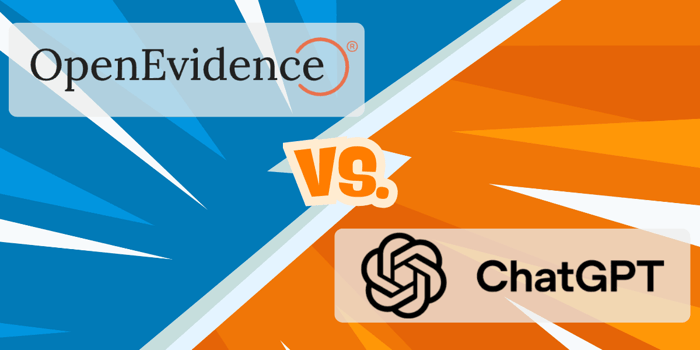
What Makes This Different From ChatGPT:
- Sources are peer-reviewed and curated
- Citations are directly linked and verifiable
- Lower hallucination risk
What AI Does Well: Rapid synthesis of literature, highlighting key recommendations, and reducing search time.
Where to Be Careful: Still verify before applying clinically. Don't rely on summaries alone for complex cases.
Clinical Bottom Line: Use AI to find evidence faster, not to replace critical appraisal.
Best Tool for the Job: OpenEvidence
Why: Built specifically for clinicians using peer-reviewed sources and clinical practice guidelines with verifiable citations.
Best Use: Clinical practice guideline lookup, evidence-based treatment questions, quick literature synthesis with citations.
Use It When: You need defensible, citable clinical information.
Avoid Using It For: Creative tasks (writing, patient education), non-clinical workflows.
Product Spotlight:
Get This Course and More with an Unlimited Membership. Learn More Here >
Where This Actually Helps in Practice
These workflows don't require new software systems, major training, or workflow overhauls. They fit into what you're already doing. And the impact is real: less time documenting, clearer patient communication, and faster access to evidence.
Quick Summary: Use the Right Tool for the Task
| Task | Best Tool | Why |
| SOAP note cleanup | ChatGPT (or similar) | Strong at organizing and formatting |
| Patient education handout | ChatGPT | Excellent at simplifying complex language |
| Clinical practice guideline lookup | OpenEvidence | Peer-reviewed only, inline citations |
| Literature synthesis | OpenEvidence / PerplexityAI | Verifiable sources, lower hallucination risk |
AI in healthcare is often framed as something futuristic or disruptive. In reality, its most immediate value is much simpler:
It removes friction from the parts of your job that slow you down.
Used well, it gives you more time for what actually matters: clinical reasoning, patient interaction, and better outcomes. Used poorly, it introduces risk. The difference is not the tool - it's how you use it. For physical therapists and occupational therapists especially, that distinction matters.
FAQs
Do I need special software or technical skills to use these AI workflows?
No. All three workflows use conversational interfaces - you type or paste your content, and the tool responds in plain language. ChatGPT requires only a free account. OpenEvidence requires a free account verified with your NPI number or professional email. The most important skill is learning to write clear, specific prompts and knowing when to verify the output against your own clinical judgment.
Can I use ChatGPT for documentation if my clinic hasn't approved it?
Not safely, no. If your organization hasn't explicitly approved a tool for HIPAA-compliant use, you should assume it is not cleared for any patient-related content. Even de-identified notes carry risk if your employer's policy prohibits unapproved tools. Check with your compliance officer or IT department before using any AI tool for documentation purposes. Several HIPAA-compliant versions of ChatGPT exist (such as ChatGPT for Healthcare, BastionGPT, and Hathr.ai) that may be worth raising with your organization.
When should I use OpenEvidence instead of just searching PubMed?
Use OpenEvidence when you need a fast, synthesized answer to a specific clinical question and don't have time to run a full literature search. It's particularly useful at the point of care - between patients, before a complex case, or when a patient asks a question you want to answer accurately. PubMed remains the gold standard for raw data and rigorous research, and OpenEvidence itself will often surface the same foundational studies. Think of OpenEvidence as the starting point that gets you to the right answer faster, with PubMed as your verification layer for high-stakes clinical decisions.