Table of Contents
For most clinicians, including PTs, OTs, RNs, and ATCs, the "Google search" era of clinical research is diminishing rapidly. If you are looking for the best medical AI platform to find clinical practice guidelines (CPGs) or evidence-based protocols, you have likely considered the two biggest names in the space: OpenEvidence and ChatGPT.
While ChatGPT has become the "household name" for AI - used as both a noun and a verb - OpenEvidence is the specialized tool built specifically for the high-stakes world of healthcare. Here is a head-to-head breakdown to help you decide which AI tool best fits your clinical workflow and patient care needs.
OpenEvidence: The "Surgical Scalpel" for Clinical Truth
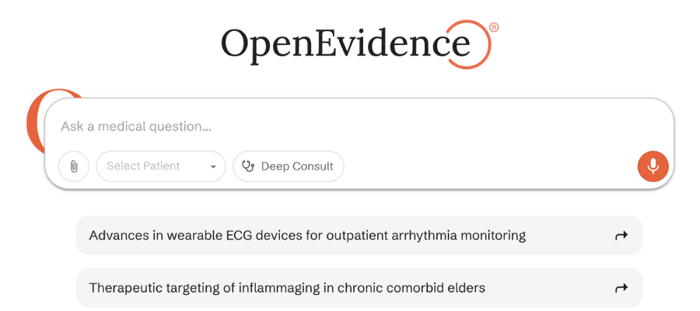
OpenEvidence is included in the National Library of Medicine’s digital collection and is the official AI partner of the New England Journal of Medicine. It isn't just "chatting" - it is querying a curated, high-fidelity database of medical literature and official clinical guidelines.
OpenEvidence is already significantly adopted and is being used by over 40% of U.S. Physicians, with over 100 million American patients being treated by a clinician using OpenEvidence. Its claim to fame is its aggregation and synthesis of peer-reviewed literature, including content from JAMA, NEJM, NCCN, Wiley, and Cochrane.
The Vibe: It feels like a conversation with a highly specialized medical librarian who only speaks only in peer-reviewed citations.
Best For: Finding specific Clinical Practice Guidelines (CPGs), dosage recommendations, and "Gold Standard" protocols.
The "Killer Feature": Inline Snippets. When OpenEvidence gives you an answer, you can hover over the citation to instantly view the exact sentence from the original source. You don't even have to open the source, streamlining verification without extra clicks.
Pricing: Free for Healthcare Professionals (requires NPI or professional email verification).
ChatGPT: The "Swiss Army Knife" for General Productivity
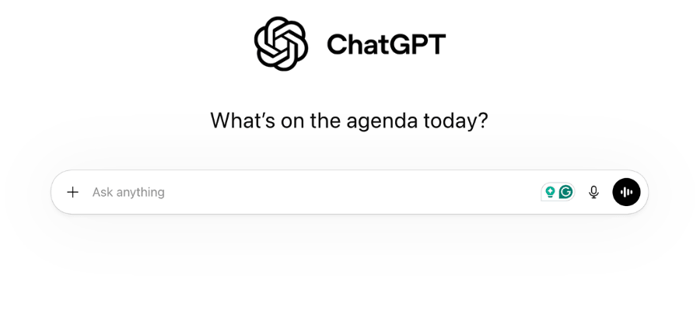
ChatGPT is a widely recognized AI tool known for its versatility. It is a general-purpose Large Language Model (LLM) that can be utilized in a wide variety of settings, from students to professionals. In everyday life, it can be used to write emails, summarize text, and answer general questions. For clinicians, it can simplify tasks such as drafting patient education materials and summarizing clinical notes. While it is incredibly powerful, it was trained on the "entire internet," not just medical journals, which sometimes results in an inaccurate or incomplete synthesis of information.
The Vibe: It feels like a brilliant, all-knowing assistant who is great at writing but occasionally "hallucinates" (makes up) facts or citations.
Best For: Drafting patient education materials, creating study outlines, summarizing long notes, or brainstorming clinical scenarios.
The "Killer Feature": Creative Synthesis. You can ask it to "rewrite this complex post-op protocol into a 5th-grade reading level for a patient handout," and it will do it perfectly in seconds.
Pricing: Free (GPT-4o mini) / $20/mo (Plus for full GPT-4o access and custom GPTs).
Head-to-Head Comparison: OpenEvidence vs. ChatGPT
| Feature | OpenEvidence | ChatGPT |
| Primary Source | Peer-Reviewed Journals & CPGs | General training data (the internet at large) |
| Hallucination Risk | Extremely Low (medical-grade) | Moderate (can “invent” citations and data) |
| Best Use Case | "What is the CPG for X?" | "Write a patient handout for X." |
| Verification | Inline text snippets | None (you must manually verify) |
| Target Audience | Clinicians & Researchers | General Public & Professionals |
The Verdict: For clinicians requiring precise and defensible clinical answers at the bedside or in the clinic, OpenEvidence often proves to be the more reliable choice. If you are looking to save time on administrative tasks, such as drafting discharge summaries or creating patient-friendly explanations of complex topics, ChatGPT is your best friend.
Product Spotlight:
AI In Rehabilitation: Evidence-Based Update

$37.97
Unlock the future of clinical practice with AI in Rehabilitation: An Evidence-Based Update, a premier continuing education course designed specifically for physical therapists, occupational therapists, and nurses. As artificial intelligence fundamentally reshapes rehabilitation medicine, this course provides you with the… read more
Get This Course and More with an Unlimited Membership. Learn More Here >
Other Medical AI Tools to Consider
While OpenEvidence and ChatGPT are the current leaders for "on-the-job" answers in healthcare, your AI toolkit shouldn't stop there. If you are diving deeper into clinical research, consider these specialized "power tools":
- Consensus: Best for "Yes/No" evidence checks. It uses a "Consensus Meter" to show you if the bulk of research supports or refutes a specific clinical claim.
- SciSpace: The ultimate "PDF Whisperer." If you have a dense, 40-page systematic review, upload it to SciSpace and ask, "Explain the results section like I'm a student."
- PubMed (AI-Enhanced): Still the gold standard for raw data. Use it to verify the foundational research that the AI tools surface to ensure your practice remains beyond reproach.
Final Thought: AI is not here to replace your clinical judgment; it is here to be integrated into your daily workflow to reduce the "cognitive load" of accessing and applying evidence-based information. By integrating these tools into your workflow, you can spend less time scrolling through search results and more time applying the latest evidence to your patients' lives.
⚕ Practical Safety Notes for Clinicians
- AI tools can mis-summarize methods, effect sizes, and contraindications — always verify against the actual paper and guidelines.
- Do not upload PHI or institution-restricted documents into AI tools unless your policy explicitly allows it.
- Use AI to speed workflow, not to "decide" clinical care.
FAQs
Is OpenEvidence or ChatGPT more reliable for clinical guidelines?
For specific Clinical Practice Guidelines (CPGs) and "Gold Standard" protocols, OpenEvidence is the more reliable choice. It is indexed in the National Library of Medicine and provides inline snippets from peer-reviewed journals like NEJM and JAMA, allowing you to verify claims without opening a PDF. ChatGPT is a general-purpose tool and carries a higher risk of "hallucinating" or inventing medical citations.
Can I use these AI tools to create patient education materials?
Yes, ChatGPT is the superior tool for this task. Its "Killer Feature" is creative synthesis, allowing you to take a complex post-op protocol and instantly rewrite it into a 5th-grade reading level or a simplified handout. OpenEvidence is designed for technical clinical truth rather than creative drafting. AI should not be used to replace your own clinical expertise, but simply to speed workflow.
Are these AI platforms free for healthcare professionals?
OpenEvidence is currently free for healthcare professionals, though it requires verification via an NPI number or a professional email address. ChatGPT offers a free version (GPT-4o mini), while the full-featured version (GPT-4o) requires a $20/month "Plus" subscription.
Is it safe to upload patient information into these AI tools?
No. You should never upload Protected Health Information (PHI) or restricted institutional documents into these tools. As the article notes, AI should be used to reduce "cognitive load" and speed up your workflow, but it should never replace your clinical judgment or violate patient privacy protocols.
Ready to Learn More about AI in Healthcare?
Join the Ridley Learning Unlimited CE Membership to get unlimited access to continuing education courses on AI and so much more!
Learn More About Membership