Table of Contents
- What Fear-Avoidance and Kinesiophobia Actually Are
- The Evidence: Selhorst RCT
- The Screening: Two Minutes That Change the Program
- The Protocol: Layered Onto PT, Not Replacing It
- What This Sounds Like in Clinic
- When to Refer to Psychology or Psychiatry
- Why This Matters Most in Adolescents
- Where This Fits
- The Bottom Line
- FAQs
Clinical Summary:
The Gap: PFP rehabilitation that addresses only the biomechanics underperforms when fear-avoidance, kinesiophobia, or pain catastrophizing are elevated. Most clinicians don't screen for these factors and therefore don't know they're driving the limited response.
The Evidence: The Selhorst RCT on psychologically informed education for adolescents demonstrated significant reductions in fear-avoidance, kinesiophobia, and pain catastrophizing, with corresponding improvements in function and pain over standard PT. Hart systematic review confirms the prognostic relevance across knee conditions.
The Takeaway: A two-minute kinesiophobia screen, brief pain neuroscience education, and graded exposure to feared activities take minimal clinical time and produce outsized outcome gains.
A 14-year-old soccer player has been in PT for six weeks. Quad strength tests at 5 out of 5. Hip strength is normal. Dynamic valgus minimal. Her Kujala score has barely moved. She's stopped taking the stairs at school. She walks the long way around her house to avoid the basement steps where her pain started. Her mom is worried she's "babying it." The physical exam doesn't explain why she's not getting better.
What explains it is sitting on a questionnaire most clinics don't administer. Her Tampa Scale of Kinesiophobia score is 42, indicating significant movement-related fear. Until that's addressed, the strengthening program will continue to underperform. Psychologically informed patellofemoral pain care is not a separate intervention parallel to PT, it's a layer woven into the PT program that changes what the strengthening actually accomplishes.
The evidence for this is recent and strong. The Selhorst RCT on adolescents established the protocol. The Hart systematic review confirmed the prognostic relevance across knee conditions. Adding the psychologically informed components takes minimal clinical time and produces outcomes that strengthening alone cannot reach.
What Fear-Avoidance and Kinesiophobia Actually Are
Fear-avoidance is the belief that activity will cause harm or worsen the underlying condition. Patients with fear-avoidance progressively restrict activities they perceive as threatening. They avoid stairs, kneeling, running, sports, sometimes at the cost of social, occupational, or developmental participation.
Kinesiophobia is closely related: the fear of movement itself. Both concepts capture the cognitive and emotional layer that sits on top of nociception and shapes how a patient responds to pain signals.
Pain catastrophizing is a related construct: the tendency to interpret pain as a sign of serious damage, ruminate about it, and feel helpless about it.
None of these are "soft" or "psychological in a way that's separate from the physical." They are central nervous system processes that modulate pain perception, motor output, and behavioral choices in measurable ways. Untreated, they predict poorer outcomes regardless of the quality of the strengthening program.
Fear-avoidance is not a soft factor. It is a central nervous system process that shapes how the strengthening program performs.
The Evidence: Selhorst RCT
Selhorst and colleagues conducted a randomized controlled trial of psychologically informed education for adolescents with patellofemoral pain. The intervention was a video-based education series addressing pain neuroscience, fear-avoidance, and activity modification strategies, delivered as adjunct to standard physical therapy.
The findings:
- Significant reductions in fear-avoidance beliefs.
- Significant reductions in kinesiophobia (Tampa Scale of Kinesiophobia).
- Significant reductions in pain catastrophizing (Pain Catastrophizing Scale).
- Significant improvements in function and pain compared to control group receiving standard education videos.
The intervention added minimal clinical time. The mechanism appears to be modification of cognitive and emotional contributors to symptom perception and activity restriction. The video-based delivery makes the protocol implementable at scale.
The Hart systematic review and meta-analysis on knee confidence, fear of movement, and psychological readiness across knee conditions established the broader prognostic relevance. Elevated fear-avoidance is associated with greater pain intensity, reduced function, and lower return-to-sport rates. The pattern holds across PFP, ACL injury, knee OA, and post-surgical populations.
Selhorst RCT Effect:
Sig
Significant reductions in fear-avoidance, kinesiophobia, and catastrophizing over standard PT in adolescent PFP.
The Screening: Two Minutes That Change the Program
Most PFP rehabilitation programs do not include psychological screening. Adding it is the highest-leverage change a clinician can make to their evaluation routine.
Tampa Scale of Kinesiophobia (TSK-11 or TSK-17). 11- or 17-item self-report measure of fear of movement and reinjury. Cutoff scores around 37-40 (TSK-17) indicate elevated kinesiophobia. Takes 2-3 minutes.
Pain Catastrophizing Scale. 13-item self-report. Scores above 24 considered clinically significant. Takes 2-3 minutes.
Fear-Avoidance Beliefs Questionnaire. Two subscales (physical activity, work). Useful in adult populations.
For chronic or recurrent PFP, screening at initial evaluation is standard. For adolescents, screening at initial evaluation is also recommended given the Selhorst evidence on intervention efficacy in this population. For acute presentations responding well to standard care, screening may be deferred to a re-evaluation if progress stalls.
A directed clinical interview is an alternative when standardized instruments aren't practical: "Tell me about the activities you've stopped doing because of your knee. How does it feel to think about going back to those activities? What do you think is happening in your knee when you do them?"
The Protocol: Layered Onto PT, Not Replacing It
Psychologically informed PFP care does not replace strengthening, gait retraining, or any of the standard PT interventions. It layers onto them. The components:
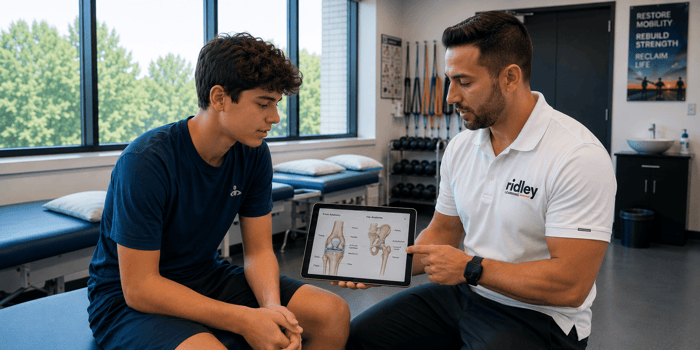
1. Pain neuroscience education. Explain that pain is a nervous system output, not a direct readout of tissue damage. That central sensitization can make movements feel more painful than they "should" based on the tissue alone. That movement is safe and progressive loading is protective rather than destructive. For adolescents, the Selhorst video-based protocol is a validated format. For adults, the Explain Pain principles work similarly.
2. Cognitive reframing. Identify catastrophic interpretations of symptoms ("if it hurts, I'm damaging my knee"). Replace with more accurate framings ("hurt does not always equal harm; this is my nervous system being sensitive, not my joint being damaged").
3. Graded exposure to feared activities. Construct a hierarchy of avoided activities. Start with the least-threatening. Practice repeatedly until anxiety diminishes. Progress to the next level. This is identical to graded exposure in anxiety treatment because the mechanism is the same, disconfirming the catastrophic prediction through experience.
4. Activity modification framed as temporary, not permanent. Modifying training load is acceptable; eliminating activities entirely reinforces the avoidance pattern. Frame any reductions as a temporary step toward the return to full participation.
5. Self-efficacy building. Celebrate progress on the avoided activities. Document gains. Use them as evidence against the catastrophic predictions.
Product Spotlight:
Patellofemoral Pain Syndrome: Differential Diagnosis and Management for Athletes

$37.97
This evidence-based course on Patellofemoral Pain Syndrome (PFPS) teaches clinicians how to diagnose, differentiate, and manage anterior knee pain across diverse populations including athletes, adolescents, and military personnel. Participants will learn advanced clinical examination techniques, including physical and psychosocial assessments,… read more
What This Sounds Like in Clinic
The conversation with an adolescent or young adult patient (and family, where appropriate) doesn't take long. A workable framing:
"Your knee imaging is normal and your strength is good. The pain you're feeling is real, and your nervous system is what's generating it, not damage in the joint. That's actually good news, because it means we can treat this. The other piece is that you've stopped doing a lot of things because of the pain, the stairs, kneeling, the things that scare you. The longer you avoid those, the more sensitive your system gets to them. So part of the plan is going to be gradually going back to those activities in a controlled way. It might be uncomfortable at first, but it's going to teach your nervous system that those movements are safe again. That's how we get you out of this."
For parents and family members of adolescents: "Your daughter's not babying it. Her nervous system is in a protective pattern that we're going to work out of. The best thing you can do is encourage her to do the activities even when they feel uncomfortable. Avoiding them is what's keeping the pattern in place."
This is a 90-second conversation. It changes the trajectory of care.
When to Refer to Psychology or Psychiatry
Psychologically informed PT is within scope of practice. It is not psychotherapy. When patients present with severe depression, anxiety, or trauma history that exceeds the scope of psychologically informed PT, referral to mental health is appropriate.
Indicators that referral may be warranted: persistent very high TSK scores despite intervention, prominent depression or anxiety symptoms beyond what's reasonable for the physical condition, history of trauma contributing to chronic pain presentations, or stalled progress despite adequate PT plus psychologically informed care.
The PT or OT does not need to deliver psychotherapy. They need to recognize when it's appropriate to refer and how to maintain the therapeutic alliance through that referral.
The Jaffri and Baellow analysis compared mental health status in individuals with PFP versus other knee conditions versus healthy controls. PFP patients demonstrated lower physical and mental health component scores than both comparison groups. The relationship is bidirectional (chronic pain affects mental health, and mental health affects pain perception) but the practical implication is that mental health screening belongs in the standard PFP evaluation.
Why This Matters Most in Adolescents
The Selhorst RCT was conducted in adolescents specifically, and the population matters. Adolescent PFP peaks at age 13 and frequently extends into young adulthood. The 50-60% one-year persistence rate is, in part, an adolescent persistence rate. The pattern of activity avoidance that develops at age 13-14 can shape athletic identity, sports participation, social engagement, and long-term physical activity habits.
The intervention window for changing trajectory is narrow. A 14-year-old who learns that movement is safe, that pain is not the same as damage, and that gradual exposure works is a 14-year-old who can return to soccer, volleyball, basketball, or whatever defined their athletic life. The 14-year-old who doesn't get that conversation often becomes the 18-year-old who's stopped playing entirely.
Where This Fits
Psychologically informed care is one of three contemporary additions to PFP management. The full operating model is in the patellofemoral pain syndrome treatment pillar. The combined hip-and-knee strengthening evidence sits in the combined hip-and-knee evidence breakdown. The kinetic-chain sentinel finding is in the 46.6% adjacent-joint sentinel finding.
The Bottom Line
Psychologically informed patellofemoral pain care is the layer that makes the strengthening program perform to its potential in patients with elevated fear-avoidance or kinesiophobia. The Selhorst RCT establishes the evidence in adolescents. The Hart systematic review extends the prognostic relevance across knee conditions. Adding the layer takes minimal clinical time and produces outsized outcome gains. For any chronic or recurrent PFP patient and for any adolescent presentation, it is no longer optional.
FAQs
What is psychologically informed patellofemoral pain care, in one sentence?
It is a layer of pain neuroscience education, cognitive reframing, and graded exposure to feared activities added to standard PT, designed to address the fear-avoidance and kinesiophobia that frequently drive limited response in PFP patients, particularly adolescents and chronic cases.
Do I need to be trained in psychology to deliver psychologically informed care?
No. Psychologically informed practice is within PT and OT scope. It involves applying basic pain neuroscience principles, recognizing fear-avoidance patterns, and using graded exposure. It is not psychotherapy. Referral to mental health is appropriate when patients present with severe depression, anxiety, or trauma exceeding the scope of psychologically informed PT.
What's the minimum I should add to my current PFP evaluation?
The Tampa Scale of Kinesiophobia (TSK-11) takes 2-3 minutes and identifies the patients who need the psychologically informed layer added. For adolescents, default to including it. For chronic or recurrent PFP, default to including it. For acute uncomplicated PFP responding well to standard care, optional but low-cost to add.
How quickly does psychologically informed care produce changes in fear-avoidance?
The Selhorst RCT showed measurable reductions in fear-avoidance, kinesiophobia, and catastrophizing across the intervention period (8-12 weeks of program participation). Initial reductions can appear within 2-4 weeks of consistent practice with graded exposure and education. Sustained change requires ongoing reinforcement throughout the rehabilitation episode.
What if my patient or their family resists the idea that psychology is part of PT?
Reframe it as "your nervous system is part of how pain works, and we're going to address that part of the system the same way we're addressing your hip strength." Avoid the word "psychological" if it triggers resistance. The educational content and graded exposure work regardless of the label. The Selhorst protocol's video-based format helps depersonalize the intervention.