


Verify Course Approval
Concussion Management in Adolescents and Adults: Evidence Based Update
Get This Course and More with an Unlimited Access CE Subscription!
Unlimited access to the entire library of CE courses included
Flexibility to complete your CE on your schedule, wherever you are!
New courses developed regularly, so you'll have up-to-date content to meet your needs and requirements
Course Description
Concussion Management in Adolescents and Adults: Evidence-Based Update provides healthcare professionals with a comprehensive, up-to-date synthesis of the latest research and international consensus guidelines shaping modern concussion care. Grounded in evidence published between 2022 and 2025, this course moves beyond outdated “cocooning” models and equips clinicians with practical strategies for early active rehabilitation, targeted management of persistent symptoms, and safe return-to-sport, school, and work decision-making.
Through in-depth exploration of the SCAT6 and SCOAT6, cervicovestibular and oculomotor rehabilitation, pharmacological considerations, and interdisciplinary care models, participants gain actionable tools they can implement immediately in clinical practice. Special emphasis is placed on adolescent recovery patterns, sex-specific differences, and risk factors for prolonged symptoms; critical knowledge for optimizing outcomes. This course is ideal for rehabilitation and nursing professionals seeking to elevate their concussion management skills with clinically relevant, evidence-based guidance that reflects current best practice standards.
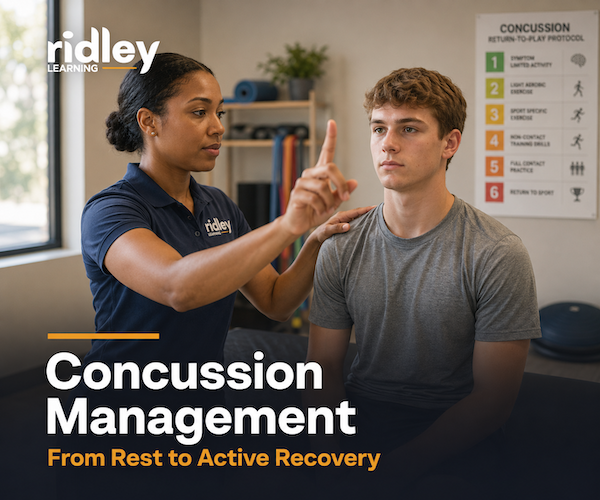
Concussion Management in Adolescents and Adults: Evidence Based Update
Additional Course Details
0:00 - Introduction
5:05 - Module 1: Concussion Assessment
19:57 - Module 2: Acute Concussion Management
35:31 - Module 3: PPCS
50:31 - Module 4: Pharmacological Landscape
1:05:12 - Module 5: Return-to-Sport Protocol
1:19:56 - Module 6: Return-to-School Strategies
1:34:16 - Module 7: Objective Assessment Tools
1:50:19 - Module 8: Case Study
2:13:14 - End
- Identify the key components and discipline-specific roles of the SCOAT6 and SCAT6 concussion assessment tools.
- Differentiate between current evidence-based acute concussion management strategies and outdated approaches such as strict rest.
- Select appropriate targeted interventions for persistent postconcussion symptoms based on identified risk factors.
- Recognize the current evidence for pharmacological interventions used to manage persistent postconcussion symptoms.
- Apply the graduated six-stage return-to-sport protocol, including symptom threshold criteria and age-specific modifications.
- Differentiate between cognitive and physical workload demands when planning individualized return-to-school and return-to-work protocols.
- Identify appropriate objective assessment tools for guiding return-to-activity decisions and monitoring concussion recovery.
Personnel Disclosure:
Financial – Anne Osborn, PT, MPT is the member manager of Ridley Learning. She receives compensation for the authorship of this course.
Nonfinancial - no relevant nonfinancial relationship exists.
No relevant conflicts of interest exist for any member of the activity planning committee.
Intermediate
Cancellation Policy: For activity cancellation, returns, or complaint resolution, please contact us by email help@ridleylearning.com. We have a 100% satisfaction guarantee. Refunds will be issued for courses who's credit has not been issued (exams have not been completed), or for any course that has been rejected by your board of approval. Webinar cancellations and exchanges must be completed 24 hours prior to the scheduled start time.