


Verify Course Approval
Florida Mandatory: Human Trafficking for Florida Nurses
Get This Course and More with an Unlimited Access CE Subscription!
Unlimited access to the entire library of CE courses included
Flexibility to complete your CE on your schedule, wherever you are!
New courses developed regularly, so you'll have up-to-date content to meet your needs and requirements
Course Description
This course meets the Human Trafficking course requirement for Florida Nursing Professionals.
Human trafficking is a hidden public health crisis in Florida—and nurses are often the first (and only) professionals to see victims outside a trafficker’s control. This engaging, Florida-specific course (required by Florida Statute 456.0341) teaches you how to recognize high-risk situations and spot real-world clinical indicators of both sex and labor trafficking. You’ll learn practical, trauma-informed screening techniques that protect patient safety, build trust, and open the door to disclosure without escalating risk. This course walks you through Florida’s reporting pathways. You’ll also gain best-practice guidance for objective, defensible documentation that supports continuity of care and potential future legal action. Six realistic case studies across Florida settings (ED, urgent care, pharmacy, agriculture, foster youth, and male victims) help you turn knowledge into confident action.
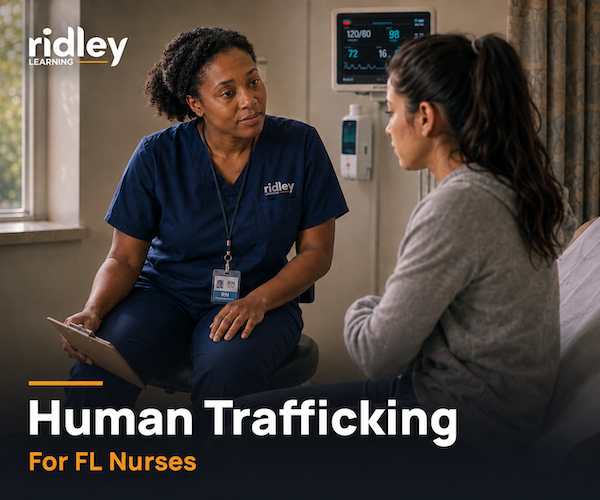
Florida Mandatory: Human Trafficking for Florida Nurses
Additional Course Details
0:00 - Introduction to Human Trafficking for Florida Nurses
2:00 - Understanding the Scope of Human Trafficking in Florida
5:34 - Defining Human Trafficking
8:27 - Module 1: Types and Dynamics of Human Trafficking
18:36 - Dispelling Myths About Human Trafficking
21:40 - Module 2: Identifying At-Risk Populations
25:23 - Recognizing Clinical Indicators
28:09 - Psychological and Behavioral Indicators
32:54 - Module 3: Patient-Centered Screening and Assessment
34:26 - Implementing Trauma-Informed Care
37:15 - Creating a Safe Environment for Disclosure
40:27 - Screening Techniques and Questions
43:38 - Module 4: Mandatory Response and Reporting
49:54 - Best Practices for Documentation
54:05 - Module 5: Connecting Victims to Care
56:17 - Continuum of Care and Key Services
58:37 - Resources and Referrals in Florida
62:40 - Key Takeaways
66:10 - Module 6: Clinical Case Studies
68:08 - Case Study 1: Emergency Department
77:50 - Case Study 2: Labor Trafficking in Agriculture
83:42 - Case Study 3: Domestic Servitude
90:24 - Case Study 4: Community Pharmacy
97:12 - Case Study 5: Foster Youth
103:50 - Case Study 6: Male Victims of Trafficking
120:29 - End
- Differentiate between legal definitions of sex and labor trafficking, including minor victims.
- Identify five key risk factors for human trafficking vulnerability.
- Recognize ten physical, psychological, or behavioral indicators of human trafficking in a clinical setting.
- Describe and apply trauma-informed care principles for human trafficking screening.
- Select appropriate mandatory reporting pathways for minor vs. adult trafficking victims in Florida.
- Identify three types of survivor services in Florida, and state/national resources.
Personnel Disclosure:
Financial – Anne Osborn, PT, MPT is the member manager of Ridley Learning. She receives compensation for the authorship of this course.
Nonfinancial - no relevant nonfinancial relationship exists.
No relevant conflicts of interest exist for any member of the activity planning committee.
Intermediate
Cancellation Policy: For activity cancellation, returns, or complaint resolution, please contact us by email help@ridleylearning.com. We have a 100% satisfaction guarantee. Refunds will be issued for courses who's credit has not been issued (exams have not been completed), or for any course that has been rejected by your board of approval. Webinar cancellations and exchanges must be completed 24 hours prior to the scheduled start time.