


Verify Course Approval
Lumbar Spinal Stenosis: Evidence-Based Update
Get This Course and More with an Unlimited Access CE Subscription!
Unlimited access to the entire library of CE courses included
Flexibility to complete your CE on your schedule, wherever you are!
New courses developed regularly, so you'll have up-to-date content to meet your needs and requirements
Course Description
This course offers healthcare professionals a comprehensive review of lumbar spinal stenosis, focusing on differential diagnosis, validated assessment criteria, and evidence-based rehabilitation protocols. Participants will learn to differentiate stenosis types, apply clinical reasoning to complex cases, and select appropriate interventions, including manual therapy, flexion-based exercises, and aerobic conditioning. The course also covers outcomes of rehabilitation versus surgery and strategies for managing older adults with comorbidities, ensuring optimal, patient-centered care.
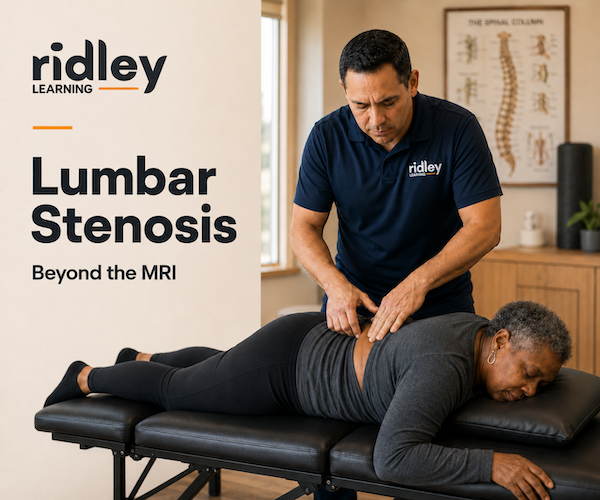
Lumbar Spinal Stenosis: Evidence-Based Update
Additional Course Details
0:00 - Introduction to Lumbar Spinal Stenosis
3:23 - Pathophysiology and Classification
14:00 - Anatomical Classification and Imaging
22:10 - Clinical Assessment and Diagnosis
52:37 - Rehabilitation Protocols
74:01 - Advanced Strategies and Special Populations
95:56 - Outcomes and Decision-Making
113:06 - Case Studies and Conclusion
- Differentiate between central canal stenosis, lateral recess stenosis, and foraminal stenosis based on anatomical location, pathoanatomical features, and characteristic clinical presentations.
- Contrast lumbar spinal stenosis from key differential diagnoses—including peripheral artery disease, hip osteoarthritis, lumbar disc herniation, and diabetic peripheral neuropathy—using specific clinical features, physical examination findings, and diagnostic tests.
- Apply validated clinical assessment criteria, including the N-CLASS scoring system and provocative maneuvers, to evaluate patients presenting with suspected neurogenic claudication.
- Select appropriate evidence-based rehabilitation interventions—including manual therapy, flexion-based exercises, trunk stabilization, and aerobic conditioning—based on patient presentation, symptom severity, and functional status.
- Compare short-term and long-term outcomes of supervised multimodal rehabilitation versus surgical decompression, including rates of clinically meaningful improvement, complication profiles, and outcome convergence over time.
- Evaluate clinical and demographic predictors of favorable response to rehabilitation versus surgery to guide individualized treatment recommendations and shared decision-making.
- Determine appropriate exercise modifications and monitoring protocols for older adults with lumbar spinal stenosis who present with high comorbidity burden, frailty, or multiple concurrent conditions.
Personnel Disclosure:
Financial – Anne Osborn, PT, MPT is the member manager of Ridley Learning. She receives compensation for the authorship of this course.
Nonfinancial - no relevant nonfinancial relationship exists.
No relevant conflicts of interest exist for any member of the activity planning committee.
Advanced
Cancellation Policy: For activity cancellation, returns, or complaint resolution, please contact us by email help@ridleylearning.com. We have a 100% satisfaction guarantee. Refunds will be issued for courses who's credit has not been issued (exams have not been completed), or for any course that has been rejected by your board of approval. Webinar cancellations and exchanges must be completed 24 hours prior to the scheduled start time.