


Verify Course Approval
Multiple Sclerosis: Evidence Based Update
Get This Course and More with an Unlimited Access CE Subscription!
Unlimited access to the entire library of CE courses included
Flexibility to complete your CE on your schedule, wherever you are!
New courses developed regularly, so you'll have up-to-date content to meet your needs and requirements
Course Description
This comprehensive, evidence-based course is designed for healthcare professionals seeking to master the rapidly evolving landscape of Multiple Sclerosis care from 2022 through 2026. Participants will gain critical insights into the latest diagnostic criteria, emerging biomarkers like sNfL and sGFAP, and the pivotal role of "smoldering" neuroinflammation in driving long-term disability. By bridging the gap between pathobiology and clinical practice, the curriculum empowers clinicians to implement high-efficacy disease-modifying therapies and multidimensional assessment tools that directly improve patient outcomes. You will learn to identify "invisible" symptoms—such as cognitive impairment and fatigue—that often precede physical decline, ensuring you can provide proactive, patient-centered care. This course is an essential investment for any provider looking to deliver sophisticated, interdisciplinary care across the entire MS disease continuum.
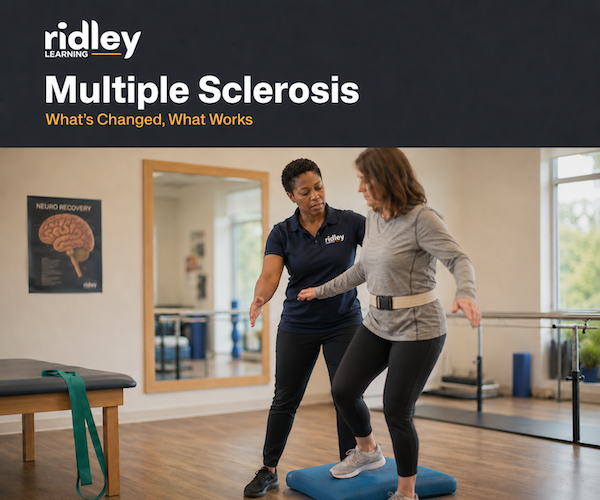
Multiple Sclerosis: Evidence Based Update
Additional Course Details
0:00 - Introduction
3:29 - Module 1: Disease Foundations
18:28 - Module 2: Diagnosis, Prognosis, and Biomarkers
35:07 - Module 3: Clinical Presentation
50:01 - Module 4: Standardized Assessment Tools and Outcome Measures
1:09:38 - Module 5: Rehabilitation Interventions
1:24:08 - Module 6: Disease-Modifying Therapies and Pharmacologic Management
1:37:30 - Module 7: Multidisciplinary Care
1:54:28 - Module 8: Case Study 1
1:57:17 - Case Study 2
1:59:27 - Case Study 3
2:01:37 - Case Study 4
2:11:07 - End
- Identify the key genetic, environmental, and immunologic risk factors for multiple sclerosis.
- Describe the clinical features and disease trajectories that distinguish the major MS subtypes.
- Explain the role of progression independent of relapse activity (PIRA) in MS disability accumulation.
- Recognize the major motor, sensory, cognitive, and invisible symptom clusters in multiple sclerosis.
- List the standardized assessment tools recommended for evaluating key functional domains in MS.
- Define the evidence-based rehabilitation interventions used across MS disease stages.
- State the roles of rehabilitation and nursing professionals in comprehensive MS care coordination.
Personnel Disclosure:
Financial – Anne Osborn, PT, MPT is the member manager of Ridley Learning. She receives compensation for the authorship of this course.
Nonfinancial - no relevant nonfinancial relationship exists.
No relevant conflicts of interest exist for any member of the activity planning committee.
Advanced
Cancellation Policy: For activity cancellation, returns, or complaint resolution, please contact us by email help@ridleylearning.com. We have a 100% satisfaction guarantee. Refunds will be issued for courses who's credit has not been issued (exams have not been completed), or for any course that has been rejected by your board of approval. Webinar cancellations and exchanges must be completed 24 hours prior to the scheduled start time.