


Verify Course Approval
Stroke Rehabilitation: Evidence-Based Update
Get This Course and More with an Unlimited Access CE Subscription!
Unlimited access to the entire library of CE courses included
Flexibility to complete your CE on your schedule, wherever you are!
New courses developed regularly, so you'll have up-to-date content to meet your needs and requirements
Course Description
Stroke rehabilitation is complex, time-sensitive, and constantly evolving—this evidence-based update equips clinicians to deliver best-practice care from acute hospitalization through community reintegration. Using research syntheses and clinical practice guideline updates (2022–2025), the course differentiates acute, subacute, and chronic-phase protocols for ischemic and hemorrhagic stroke, including safe mobilization timing and therapy “dosing.”
Learners will strengthen clinical decision-making for post-acute setting selection (IRF, SNF, home-based care, outpatient, and telerehab) and apply standardized outcome measures to guide transitions and document progress. The course also provides practical, evidence-driven exercise programming across task-specific training, aerobic conditioning (including HIIT considerations), resistance training (including blood flow restriction), balance training, and fall prevention. Emerging technologies—robotics, virtual reality, TMS/tDCS, and vagus nerve stimulation—are reviewed with clear guidance for patient selection and clinical integration. Cognitive impairment, depression/anxiety, and aphasia management are addressed as essential drivers of functional outcomes, and real-world case studies tie everything together with an emphasis on implementation barriers and health equity.
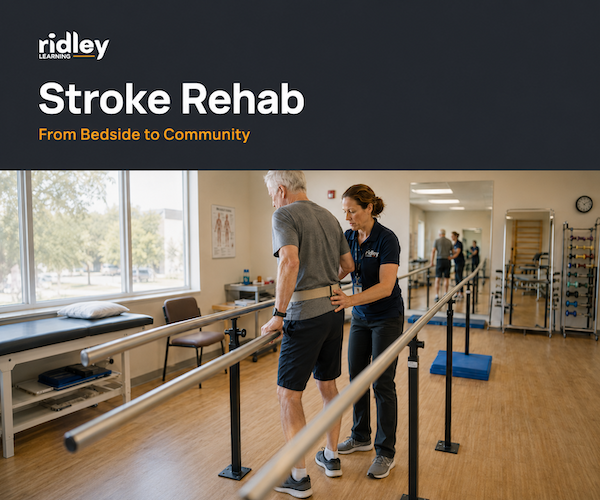
Stroke Rehabilitation: Evidence-Based Update
Additional Course Details
0:00 - Introduction
2:37 - Learning Objectives
4:01 - Module 1: Phase-Specific Rehabilitation Protocols
22:01 - Module 2: Rehabilitation Setting Selection
38:00 - Module 3: Exercise-Based Interventions
56:17 - Module 4: Emerging Rehabilitation Technologies
87:26 - Module 6: Implementation Barriers and Health Equity
96:30 - Module 7: Integrative Case Studies
97:40 - Case Study 1
107:57 - Case Study 2
118:49 - Conclusion
126:35 - End
- Differentiate acute, subacute, and chronic phase protocols by timing, intensity, and interventions for ischemic and hemorrhagic stroke.
- Evaluate patient factors (severity, cognition, comorbidities, support) to determine appropriate rehabilitation settings across recovery phases.
- Compare exercise interventions (task-specific, aerobic, resistance, balance) for optimizing motor recovery at different phases.
- Analyze evidence for emerging technologies (robotics, VR, TMS, VNS) to identify appropriate candidates and applications.
- Interpret screening tools for depression, anxiety, and cognitive impairment, and identify evidence-based communication rehabilitation approaches.
- Analyze implementation barriers across practice settings and identify strategies to promote health equity in rehabilitation.
- Select outcome measures, interventions, and follow-up intervals through comprehensive case analysis, integrating all modules.
Personnel Disclosure:
Financial – Anne Osborn, PT, MPT is the member manager of Ridley Learning. She receives compensation for the authorship of this course.
Nonfinancial - no relevant nonfinancial relationship exists.
No relevant conflicts of interest exist for any member of the activity planning committee.
Advanced
Cancellation Policy: For activity cancellation, returns, or complaint resolution, please contact us by email help@ridleylearning.com. We have a 100% satisfaction guarantee. Refunds will be issued for courses who's credit has not been issued (exams have not been completed), or for any course that has been rejected by your board of approval. Webinar cancellations and exchanges must be completed 24 hours prior to the scheduled start time.