Table of Contents
Clinical Summary:
The Gap: Many recreational runners with PFP are prescribed strengthening but never have their gait assessed. The cumulative load across thousands of strides per session is the actual driver of symptoms in this population.
The Evidence: Anderson and Crossley meta-analysis: cadence-based gait retraining produces significant pain and function improvements. De Souza Júnior RCT: gait retraining plus strengthening outperforms strengthening alone. Target step rate increase: 7.5-10%.
The Takeaway: A metronome app and a 4-6 week cadence progression is one of the highest-leverage and lowest-cost interventions in PFP rehabilitation for recreational runners.
A 34-year-old recreational runner is six months into bilateral anterior knee pain that started when he ramped his weekly mileage from 20 to 35 in preparation for a half marathon. He's done quad sets, stretches, and clamshells. He's still in pain. His baseline step rate, measured on a treadmill at his typical training pace, is 156 steps per minute.
For most clinicians looking at this case, the next step is "more strengthening" or "rest him for six weeks." The contemporary evidence on gait retraining for runners with patellofemoral pain says there's a higher-leverage intervention sitting right there in the cadence number. Bring him to 168-172 steps per minute over six weeks of consistent practice. The mechanical load on the patellofemoral joint per step drops. The total cumulative load across a typical run drops substantially. The strengthening program continues alongside it.
This is not a niche elite-runner intervention. It is the contemporary standard for recreational runners with PFP, supported by a meta-analysis and a randomized trial.
Why Cadence Changes Joint Load
Patellofemoral joint reaction forces during running reach up to seven times body weight at the knee. The peak loading occurs at midstance, where the knee is most flexed and the muscle force across the joint is highest. Increasing cadence at the same running speed reduces stride length, which reduces peak knee flexion at midstance, which lowers patellofemoral joint reaction force per step.
The cumulative effect is substantial. A 10 percent cadence increase reduces patellofemoral joint stress per step by roughly 10-15 percent. Across a 5,000-step training run, that's hundreds of thousands of newtons of load not applied to the symptomatic tissue. The strengthening program continues to build the tissue's capacity to handle load. The gait modification reduces the load arriving in the first place.
Cadence Lever:
10%
Step rate increase reduces patellofemoral joint reaction force per step and improves PFP outcomes when added to strengthening.
The Evidence
The Anderson and Crossley systematic review with meta-analysis synthesized studies on cadence-based gait retraining for PFP. The pooled effect: significant improvements in pain and function. Effect sizes were clinically meaningful and consistent across studies.
The De Souza Júnior randomized controlled trial directly tested whether gait retraining adds value when combined with strengthening. Runners with PFP were randomized to strengthening alone or strengthening plus cadence-based gait retraining (target 7.5-10% step rate increase, achieved through real-time metronome feedback). The combined intervention produced greater improvements in pain and function compared to strengthening alone. The trial provides direct RCT-level evidence for the additive benefit.
The mechanistic rationale is supported by biomechanical modeling studies that quantify the patellofemoral load reduction with cadence increase. Real-world cohort studies in recreational runner populations confirm the effect sustains beyond the clinical setting.
The cadence lever costs the clinician 90 seconds of explanation, the patient a metronome app, and the runner six weeks of consistent practice. The mechanical load reduction across a typical training week is substantial.
The Protocol
The implementation is mechanically simple:
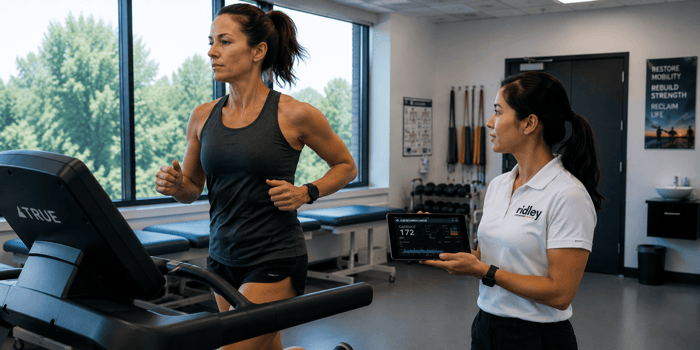
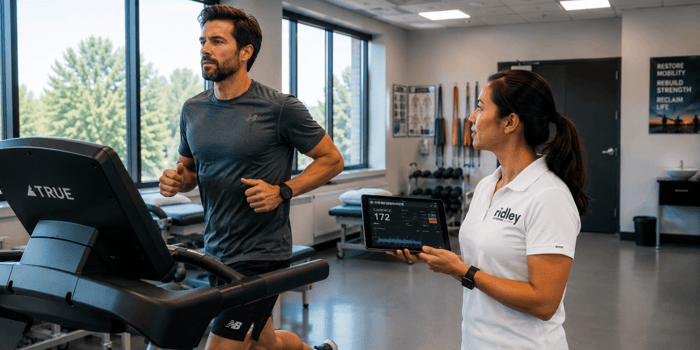
Step 1: Measure baseline cadence. On a treadmill at the patient's typical training pace, count footstrikes for 60 seconds. The patient's preferred step rate is the baseline. Most recreational runners with PFP fall in the 150-165 steps per minute range. Elite distance runners typically run 175-185.
Step 2: Calculate target cadence. Target is 107.5 to 110 percent of baseline. For a baseline of 156 steps per minute, target is 168-172. The patient does not need to feel like they're running fast. They feel like they're taking quicker, shorter steps at the same overall pace.
Step 3: Provide metronome feedback. The patient downloads a free metronome app. Set to the target cadence. The patient runs short, easy efforts matching footstrike to the metronome beats. Initial sessions should be 10-15 minutes at conversational pace. The new pattern will feel awkward for the first 1-2 weeks.
Step 4: Progress over 4-6 weeks. Increase duration and intensity of cadence-matched runs as comfort develops. Most patients achieve consistent target cadence without external cueing by week 4-6. Wean from the metronome as the new pattern becomes automatic.
Step 5: Maintain with periodic re-checks. Step rate often drifts back toward baseline if not monitored. Periodic re-measurement at 3 and 6 months supports durable change. Running watch settings that display cadence in real-time help long-term maintenance.
Concurrent Strengthening, Not Sequenced
Gait retraining is concurrent with the combined hip-and-knee strengthening program, not a sequenced "after the strengthening" step. The De Souza Júnior trial structure was concurrent. The mechanistic rationale supports concurrent intervention: the strengthening builds tissue capacity, the cadence modification reduces tissue load. Both effects compound.
The strengthening program is the standard contemporary protocol from the combined hip-and-knee evidence: hip abduction, hip external rotation, trunk stabilization, and progressive knee strengthening from week one. Cadence work layers on top.
Alternative Gait Modifications
Cadence increase is the most studied and most broadly applicable gait modification. Other strategies may be appropriate for specific patient presentations:
Footstrike transition. A shift from rearfoot to midfoot or forefoot strike reduces peak patellofemoral loading. The trade-off is increased Achilles tendon and calf loading, with a real risk of Achilles tendinopathy or calf strain during the transition. Implement only with careful gradual progression and only if the patient is willing to manage the transition risk.
Reduced trunk lean. Some PFP runners present with excessive forward lean that increases hip flexion at footstrike. Cueing slight reduction in forward lean can redistribute loading.
Lateral pelvic drop control. For runners demonstrating excessive contralateral pelvic drop, cueing for hip abductor engagement during stance phase can be added. This is more of a strengthening cue than a gait modification per se.
Cadence increase remains the first-line intervention because it is mechanically simple, immediately measurable, and has the strongest evidence base.
Product Spotlight:
Patellofemoral Pain Syndrome: Differential Diagnosis and Management for Athletes

$37.97
This evidence-based course on Patellofemoral Pain Syndrome (PFPS) teaches clinicians how to diagnose, differentiate, and manage anterior knee pain across diverse populations including athletes, adolescents, and military personnel. Participants will learn advanced clinical examination techniques, including physical and psychosocial assessments,… read more
What Goes Wrong and How to Fix It
The most common failures of gait retraining are predictable:
Target cadence too aggressive. Patients told to increase cadence by 15-20% drop the protocol because the new pattern feels too disrupted. 7.5-10% is the sweet spot: enough mechanical change to produce benefit, small enough to be sustainable.
No baseline measurement. Without baseline cadence, "increase your cadence" is unactionable. Measure first, then target.
Stopping when the runner thinks the pattern is "fixed." Without continued reinforcement, step rate often drifts back to baseline over weeks. Running watch cadence display and periodic re-checks support durable change.
Adding cadence work without strengthening. Cadence reduces load. The tissue still needs to be capable of handling the load it does receive. The combination of cadence plus strengthening is what the evidence supports.
Ignoring footwear and surface. Recent shoe change or surface change can be the precipitating event. Worth asking about. Continuing the same shoe and surface that drove the PFP onset undermines the intervention.
Most modern running watches display real-time cadence. After 4-6 weeks of metronome-cued practice, a runner using their watch's cadence display can maintain the new pattern without external cueing. This is a low-cost durability lever: the patient already owns the watch; they just need to know to check the cadence field.
For Whom Is Gait Retraining Not Indicated?
Cadence-based gait retraining is broadly applicable, but specific presentations warrant other approaches first:
Runners with marked dynamic valgus and clear hip weakness: hip strengthening should be primary; gait retraining can be added once hip capacity has begun to develop.
Patients with PFP from primarily non-running activities (squatting, stairs): cadence is irrelevant; address the contributing activities directly.
Patients with severe fear-avoidance: psychologically informed care first per the psychologically informed PFP framework; gait retraining once the patient is engaged with active rehabilitation.
Non-runners: not applicable.
Where This Fits
Gait retraining is one of three contemporary additions to the PFP protocol, combined hip-and-knee strengthening, gait retraining for runners, and psychologically informed care. The full operating model sits in the patellofemoral pain syndrome treatment pillar. The sentinel-injury data on PFP and adjacent joints sits in the 46.6% adjacent-joint finding.
The Bottom Line
Gait retraining for runners with patellofemoral pain is a 90-second clinical conversation, a free metronome app, and 4-6 weeks of consistent practice. Target 7.5-10% step rate increase. Layer concurrent with combined hip-and-knee strengthening. The Anderson and Crossley meta-analysis and the De Souza Júnior RCT establish the additive benefit. For the recreational runner who's done the strengthening and is still in pain, the cadence number is often the lever you've been missing.
FAQs
Does gait retraining for runners with patellofemoral pain work without concurrent strengthening?
The De Souza Júnior RCT specifically tested concurrent strengthening plus gait retraining versus strengthening alone, the combination won. Gait retraining alone has supportive evidence but the concurrent strengthening is what the trial structure supported. Treat both as core components, not alternatives.
What if my patient is a non-runner with PFP from stairs and squats, does gait retraining apply?
No. Cadence-based gait retraining is specifically for runners with PFP exacerbated by running. For non-runners, address the contributing activities directly (step-down training, squat mechanics, ADL modification). The kinetic-chain strengthening principles still apply.
How much does the patient need to invest in equipment for gait retraining?
A free metronome app and a treadmill or known training route. Most modern running watches display cadence, which supports maintenance, but is not required for the initial intervention. Total equipment cost: essentially zero.
What if the patient can't tolerate running at all due to PFP?
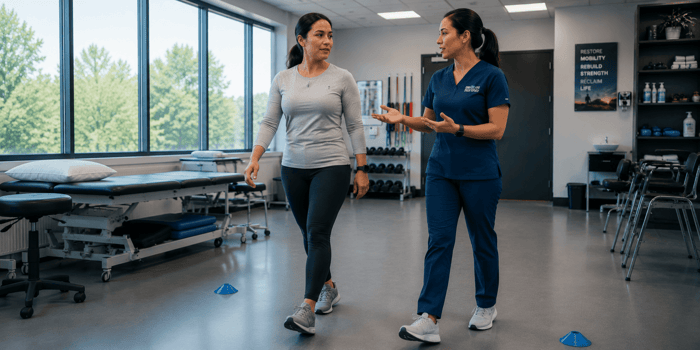
Begin combined strengthening, address fear-avoidance if present, and introduce running with cadence cueing when the patient can tolerate short easy efforts even with mild residual symptoms. The patient does not need to be pain-free to begin cadence work. Walking gait can also be assessed in this interim period for foot/ankle mechanics issues that may affect the running gait.
How long does gait retraining take to produce symptomatic change?
Most patients show subjective improvement within 2-4 weeks of consistent cadence-cued running paired with strengthening. The full motor pattern adaptation takes 4-6 weeks. Durable change requires ongoing monitoring (watch display, periodic re-checks) for at least 3-6 months.