Table of Contents
- Why Positive Signs Replaced Exclusion
- Hoover's Sign: The Most Useful Single Sign
- Drift Without Pronation: Functional Arm Weakness
- Give-Way Weakness
- Tremor Entrainment and Distractibility
- Functional Dystonia
- Functional Sensory Symptoms
- Functional Seizure Semiology
- Functional Gait Disorders
- What Positive Signs Are Not
- Scope for Non-Physician Clinicians
- Where This Fits
- The Bottom Line
- FAQs
Clinical Summary:
The Gap: FND has historically been diagnosed by exclusion, after extensive workup ruled out organic disease. The result has been prolonged diagnostic odysseys, iatrogenic harm, and patients who never received a confident diagnosis.
The Evidence: Both DSM-5-TR and ICD-11 now require positive diagnostic findings. Hoover's sign at 90-100% specificity. Tremor entrainment, tubular vision, midline splitting, characteristic functional seizure semiology. The signs are reliable, bedside-administrable, and validated.
The Takeaway: The non-specialist clinician who learns the positive signs framework can recognize FND, contribute to confident diagnosis, and deliver discipline-specific rehabilitation that aligns with the contemporary evidence.
A 34-year-old woman is referred to outpatient physical therapy. The referral says "lower extremity weakness, work up for FND." She's already had brain MRI, lumbar MRI, EMG, and basic labs, all unremarkable. The neurologist suspects functional but hasn't formally made the diagnosis. The patient is told "we're ruling things out." She's lost six months to that process. Her wheelchair use is now established.
The contemporary framework would have shortened her diagnostic odyssey substantially. Positive signs functional neurological disorder diagnosis is the rule-in approach that has replaced diagnosis by exclusion. Hoover's sign, tremor entrainment, tubular vision, midline splitting, and characteristic functional seizure semiology demonstrate internal inconsistency or incongruity with organic disease, directly, at the bedside, with specificity that rivals any neurological diagnostic test.
This page covers the most clinically useful positive signs, how to perform them, what their specificity tells you, and how non-specialist clinicians can use them within scope to recognize FND and contribute to the diagnostic conversation.
Why Positive Signs Replaced Exclusion
The historical diagnostic approach treated FND as what remained after organic disease was ruled out. This produced predictable problems. Patients underwent extensive testing (sometimes for years) without ever receiving a confident diagnosis. Even after the workup concluded, the "diagnosis" was framed as the absence of findings rather than the presence of any specific feature. Patients heard "we don't know what's wrong" or "everything came back normal", language that fails to convey a real diagnosis and frequently triggers continued workup elsewhere.
The contemporary classification systems (DSM-5-TR and ICD-11) now require positive diagnostic findings, not just exclusion. The shift was driven by accumulated evidence that specific clinical signs have high specificity for FND. Performed properly, they support a positive rule-in diagnosis with confidence comparable to other neurological conditions.
The clinical implication: the patient with limb weakness whose imaging is unremarkable does not require an additional six weeks of testing before the FND conversation can begin. The bedside positive signs make the diagnosis when they are present.
FND is now diagnosed in, not ruled in by default. That sentence shortens the diagnostic odyssey by months for the patients who would otherwise spend it being told "we're not sure yet."
Hoover's Sign: The Most Useful Single Sign
Hoover's sign tests for functional leg weakness. It exploits the principle of synergistic contraction: hip extension on one side is normally accompanied by reflexive hip flexion on the contralateral side. The test:
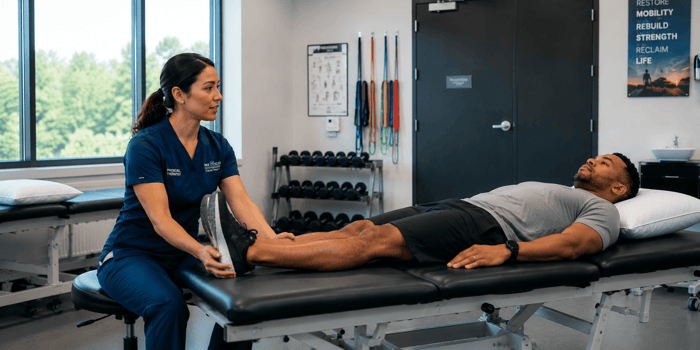
The examiner places one hand beneath the heel of the apparently weak leg. The patient is asked to flex the contralateral (non-weak) hip against resistance. In organic weakness, the weak leg shows reduced or absent downward pressure during contralateral hip flexion. In functional weakness, the weak leg demonstrates normal or near-normal downward pressure during this maneuver, the motor pathway is intact and activates reflexively, even though direct voluntary effort produces apparent weakness.
The complementary maneuver: ask the patient to lift the weak leg directly. Watch for synergistic extension in the contralateral leg. In functional weakness, the contralateral synergistic extension is preserved; the patient shows reduced effort on direct testing of the weak leg but normal activation during contralateral testing.
Specificity: 90-100% when properly performed. Sensitivity is somewhat lower (variable across studies), but the test is being used as a rule-in tool, not a rule-out screen. A positive Hoover's sign supports the diagnosis. A negative Hoover's sign does not exclude it.
Hoover's Sign Specificity:
90-100%
For functional leg weakness. Performed properly, this is a rule-in tool comparable to any neurological diagnostic test.
Drift Without Pronation: Functional Arm Weakness
Tests for upper extremity weakness. In organic upper motor neuron weakness, the patient holds both arms extended with palms upward and eyes closed. The weak arm drifts downward and pronates (palm rotates inward) due to the relative weakness of supinator muscles compared to pronators.
In functional arm weakness, the arm may drift downward but typically does not pronate, or drifts in directions inconsistent with upper motor neuron patterns. The absence of pronation distinguishes functional from organic upper motor neuron weakness. Specificity exceeds 90%.
Give-Way Weakness
Initial resistance to examiner force is present, then suddenly gives way with a ratchet-like or inconsistent quality. The patient may demonstrate brief normal strength followed by sudden collapse of effort. Strength varies markedly with repeated testing or with changes in examiner technique.
Specificity is lower than Hoover's sign (estimated 64-97% depending on context). Should be interpreted in conjunction with other positive findings. Pain-limiting behavior can produce a similar pattern and should be considered. Give-way weakness combined with other positive signs and absence of pain-limiting behavior supports functional etiology.
Tremor Entrainment and Distractibility
For functional tremor. Two complementary tests:
Tremor entrainment. Ask the patient to perform a rhythmic movement with the unaffected limb (e.g., tap the finger at a specified frequency or speed). In functional tremor, the tremor in the affected limb changes frequency to match the tapping rhythm, or is suppressed entirely while the tapping is performed. Organic tremor maintains its characteristic frequency independent of voluntary movements in other limbs.
Distractibility. Engage the patient in cognitive tasks (serial 7s, naming categories) or examine other body regions while observing the tremor. Functional tremor often diminishes or resolves with distraction. Organic tremor persists.
Both tests have high specificity for functional tremor. They are easily performed at the bedside and require no specialized equipment.
Functional Dystonia
Distinguishing functional from organic dystonia is more challenging. Key features of functional dystonia: fixed posturing from onset (rather than the mobile dystonia of organic forms), resistance to passive manipulation, inconsistent activation patterns, and onset following peripheral injury. Fixed ankle plantar flexion or fixed fist posturing (particularly from symptom onset rather than gradually developing) is highly suggestive of functional etiology.
Functional Sensory Symptoms
Midline splitting. Sensory loss that splits precisely at the midline, with an abrupt transition from normal to absent sensation. The sensory innervation of the trunk has significant overlap across the midline; organic lesions produce gradual transitions rather than sharp demarcations. Midline splitting of vibration sense is particularly useful: vibration applied to the sternum or frontal bone should be perceived symmetrically regardless of unilateral sensory loss (bone conducts to both sides). Asymmetric perception of midline vibration suggests functional sensory loss.
Non-anatomical distribution. Sensory loss not conforming to dermatomal, peripheral nerve, or central nervous system patterns. Hemisensory loss affecting face, arm, trunk, and leg identically is inconsistent with any single lesion location. Sensory loss stopping abruptly at the shoulder or hip (joint boundaries) rather than following anatomical distributions is characteristic.
Tubular vision. The field of preserved vision does not expand with testing distance. In organic visual field defects, the area of preserved vision expands proportionally as testing distance increases (visual angle constant). In functional visual loss, patients often report a fixed area of preserved vision regardless of distance, resulting in a "tube" of vision rather than a cone.
Product Spotlight:
Functional Neurological Disorders for the Non-Specialist Clinician

$37.97
This continuing education course equips healthcare professionals with the essential skills to confidently recognize, diagnose, and manage Functional Neurological Disorders (FND) - one of the most common yet frequently misunderstood conditions encountered across healthcare settings. Grounded in the latest neuroscience,… read more
Functional Seizure Semiology
Psychogenic nonepileptic seizures (PNES) (also called functional seizures or dissociative seizures) represent 20-30% of patients referred to epilepsy monitoring units for refractory seizures. The diagnosis is made through video-EEG, but several semiological features support clinical suspicion:
- Prolonged duration exceeding 2 minutes.
- Fluctuating or waxing-and-waning intensity.
- Asynchronous or out-of-phase limb movements.
- Side-to-side head shaking.
- Pelvic thrusting.
- Eye closure during the event.
- Preserved awareness during apparent bilateral motor activity.
- Crying or emotional expression during events.
- Rapid postictal reorientation without confusion.
- Recall of events that appeared to involve impaired consciousness.
No single feature is pathognomonic. The overall semiological pattern, combined with video-EEG demonstrating absence of ictal epileptiform activity during a typical event, makes the diagnosis. 10-30% of PNES patients also have coexisting epilepsy.
Functional Gait Disorders
Highly disabling and often distinctive. Characteristic features:
Excessive slowness or hesitation not explained by weakness or ataxia. Astasia-abasia: dramatic lurching and near-falls without actual falling. Improvement with distraction or when the patient believes they are not being observed. Knee buckling that does not result in falls. Uneconomic postures that require more strength to maintain than normal walking. Sudden improvement with specific interventions (walking backward, running).
Observation of spontaneous mobility (transfers, reaching, movement in the waiting room) often reveals capabilities exceeding those demonstrated during formal gait examination. This discrepancy reflects the influence of attention and self-monitoring on functional symptoms, not deliberate deception.
What Positive Signs Are Not
Positive signs do not indicate that symptoms are voluntary, fabricated, or under the patient's control. The motor pathways are intact, but the patient cannot turn the symptoms off through effort. Functional symptoms are involuntary and genuine, the lived experience of disability is real.
Positive signs do not require a trauma history. Many FND patients have significant adverse life experiences, but the diagnosis stands on the positive signs themselves, not on the presence or absence of identifiable psychological stressors.
Positive signs do not exclude organic disease. 10-25% of FND patients have coexisting structural neurological conditions. The signs identify functional symptoms; coexisting organic disease is separately evaluated.
Positive signs are not weapons. They are clinical tools used to make a confident diagnosis that opens a treatment pathway. The patient should not be made to feel "caught." Demonstration of preserved motor function during Hoover's testing is a teaching moment ("the nerve pathway to your leg is intact, that's why we have a real treatment plan for you"), not a confrontation.
The "drift without pronation" sign is one of the simplest to perform: arms extended forward with palms upward, eyes closed, for 20-30 seconds. Watch what happens to the weak arm. Organic upper motor neuron weakness produces pronation. Functional weakness does not. The maneuver takes 30 seconds and is high-specificity. Most non-specialist clinicians have never been taught it.
Scope for Non-Physician Clinicians
The formal diagnosis of FND is made by a physician (typically neurology). PTs, OTs, RNs, SLPs, ATCs, and MTs do not make the diagnosis from scratch. They can:
Recognize the positive signs during their evaluations and screenings. Hoover's sign is within PT scope as part of standard motor examination. Documentation of positive findings supports the diagnostic conversation with the referring physician.
Reinforce the diagnosis once a physician has made it. Consistent diagnostic language across the multidisciplinary team supports patient understanding and treatment engagement.
Use the positive signs as therapeutic demonstrations. The patient who watches their leg activate during Hoover's testing has direct evidence that the motor pathway is intact, which supports the rehabilitation rationale.
Communicate findings to referring providers using the contemporary positive-signs framework rather than the historical "ruled out X, Y, Z" language.
Where This Fits
The positive signs framework is the diagnostic foundation of contemporary FND practice. The full operating model sits in the FND clinician's guide pillar. The discipline-specific rehabilitation approach is in the FND rehabilitation breakdown. The diagnostic communication framework (what to say once the positive signs make the diagnosis) is in the diagnostic communication framework.
The Bottom Line
Positive signs in functional neurological disorder evaluation are the diagnostic foundation that has replaced diagnosis by exclusion. Hoover's sign, drift without pronation, tremor entrainment, tubular vision, midline splitting, and characteristic functional seizure semiology are reliable, bedside-administrable, and high-specificity. Non-specialist clinicians who learn them recognize FND in patients who would otherwise spend months or years in diagnostic limbo, and they offer those patients a confident diagnosis and an evidence-based treatment pathway.
FAQs
Can a PT or OT diagnose FND using positive signs in functional neurological disorder evaluations?
The formal diagnosis is made by a physician (typically neurology). PTs and OTs can administer Hoover's sign, drift without pronation, tremor entrainment, and other positive signs as part of standard motor examination. Documentation of positive findings supports the diagnostic conversation with the referring provider. Making the diagnosis from scratch is outside non-physician scope.
How specific are the positive signs really?
Hoover's sign: 90-100% specificity. Drift without pronation: greater than 90%. Tremor entrainment: high specificity. Tubular vision: high specificity. Give-way weakness: variable (64-97%). Specificity is generally high enough that a positive sign supports the diagnosis with confidence comparable to other neurological diagnostic tests. Multiple positive signs together strengthen the diagnostic certainty.
What about coexisting organic disease, does Hoover's sign still work?
Yes. The positive signs identify functional symptoms regardless of organic comorbidity. 10-25% of FND patients have coexisting structural disease (epilepsy, MS, stroke). The positive signs make the FND diagnosis in those patients on the same criteria as in patients without organic disease. Both conditions then receive appropriate treatment.
How do I learn to perform these signs reliably?
Video resources (multiple peer-reviewed publications include linked video demonstrations), practice on colleagues, and supervised opportunities during clinical placements with experienced clinicians. The signs are technique-dependent, poor administration produces unreliable results. Most non-specialist clinicians benefit from explicit training, not just reading a description.
What if Hoover's sign is negative but I still suspect FND?
Negative Hoover's does not exclude FND, sensitivity is variable, and the test is used for rule-in, not rule-out. Look for other positive signs. Functional sensory findings (midline splitting, non-anatomical distribution). Distractibility. Inconsistency between formal testing and observed spontaneous mobility. Multiple positive signs together strengthen the diagnostic picture.